


Living in Belgium
Living in Belgium – practical guide for EU hospitality workers
Planning to live and work in Belgium – for example as a chef, cook, kitchen assistant,
service staff, cleaner, bar staff or hotel employee?
This practical guide explains what you should know about
registration, housing, health insurance and everyday life before you move.
The information below is especially relevant for EU workers in hospitality,
but also applies to other sectors.
1. Registration and administration
As an EU citizen you can live and work in Belgium, but you must register officially after arrival.
- Identification: A valid EU passport or national ID card is sufficient.
- Municipal registration: Register at the local municipality (town hall) shortly after arrival.
- National Register number: After registration you receive a Belgian national register number,
required for work, healthcare and administration.
2. Housing and accommodation in Belgium
Most people in Belgium find housing through the private rental market.
Social housing exists, but availability is limited and waiting lists are often long.
- Rent prices vary by region (Flanders, Brussels, Wallonia).
- A written rental contract is standard.
- A deposit of one to three months’ rent is common.
Also budget for additional costs such as:
- gas, water and electricity;
- local and municipal taxes;
- waste collection and maintenance charges.
3. Health insurance and healthcare
Belgium works with mutualities (health insurance funds).
This system differs from the Netherlands and many other countries.
- You choose your own mutuality.
- Healthcare costs are partly reimbursed.
- In many cases you pay first and receive reimbursement later.
For employees, healthcare is linked to the Belgian social security system
and registration usually follows employment.
4. Lifestyle and work culture
Work-life balance
Belgium places strong value on stability, structure and predictability.
Working hours and schedules are usually agreed in advance and generally respected.
In hospitality, shifts can be demanding, but expectations around working time are
often clearly defined rather than informal.
- Stable schedules are preferred over last-minute changes.
- Overtime is typically organised and compensated rather than assumed.
Communication and workplace culture
Communication in Belgium is generally polite, careful and less direct than in the Netherlands.
People often phrase feedback diplomatically and avoid open confrontation,
especially in professional settings.
- Respect for hierarchy and roles is common.
- Feedback is often indirect and framed cautiously.
Language is region-specific:
- Flanders: Dutch
- Wallonia: French
- Brussels: Dutch and French
Daily life, food and social habits
Belgium has a strong food culture and a more reserved social style than some southern countries.
Meals are seen as moments of quality and enjoyment, and eating well is culturally important.
Social life often happens in smaller circles rather than large public gatherings.
Local traditions and regional identities are taken seriously,
and public holidays or local events can affect opening hours and work schedules.
Shopping hours and public rhythm
- Most shops close around 18:00–19:00.
- Late shopping evenings are limited and city-dependent.
- Sundays are quiet in many areas, especially outside major cities.
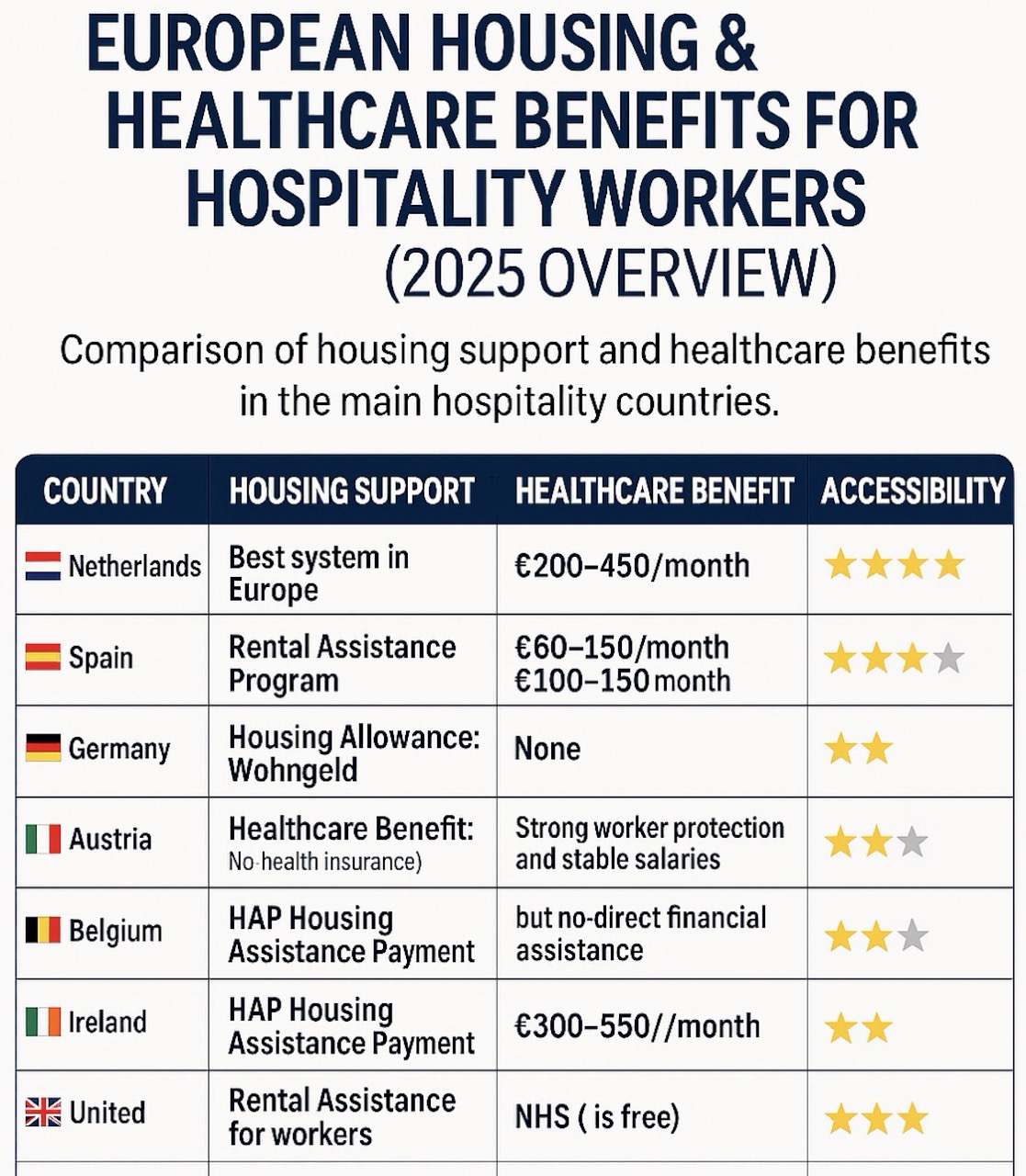
Belgium offers specific housing and healthcare-related support
for workers on lower or middle incomes.
👉
Belgium – housing & healthcare benefits for hospitality workers
5. Belgium in a European context
Belgium is part of a broader European framework of social security and worker protection.
On our overview page you can compare Belgium with other European countries:
Hospitality benefits in Europe
6. Join our international community
Want to learn more about living, working, accommodation and social security
for hospitality workers across Europe?