




Living in Ireland
Living in Ireland – practical information for EU hospitality workers
Are you planning to live in Ireland as a cook or hospitality worker?
This page provides clear and practical information about registration,
housing, healthcare and daily life in Ireland.
Administration and registration
- Identification: A valid EU passport or ID card.
- PPS Number: Required for work, taxes and social services.
- Address registration: You usually need a fixed address to apply for services.
The PPS (Personal Public Service) number is essential.
You can apply once you have proof of employment and residence.
Housing and accommodation
- Rental market: Mainly private landlords.
- Availability: Limited, especially in Dublin and other cities.
- Shared housing: Very common among hospitality workers.
- Deposit: Usually one month’s rent.
Some employers offer temporary accommodation when you arrive,
but long-term housing is usually your own responsibility.
➜ Official information on housing support:
Housing Assistance Payment (HAP)
Healthcare in Ireland
- Healthcare system: Combination of public and private care.
- Medical Card: For lower incomes (free GP and hospital care).
- GP Visit Card: Free GP visits for middle incomes.
Healthcare support depends on income and household situation.
Most hospitality workers apply after starting work in Ireland.
➜ Official healthcare information:
Medical Card & GP Visit Card – HSE
Taxes and social security
- Income tax: Automatically deducted via payroll.
- Social insurance (PRSI): Mandatory contributions.
- Benefits: Access depends on income and residence.
Once registered, taxes and contributions are handled through your employer.
Daily life in Ireland
Daily life in Ireland is shaped by an open, social culture and a relatively informal
approach to work and communication. For many EU hospitality workers, this makes it
easy to integrate and feel welcome.
Work culture & communication
Irish workplaces are generally informal but professional.
Communication is friendly and often indirect, with politeness and small talk
playing an important role. Feedback is usually delivered gently rather than directly.
Social life & pubs
Social life often centres around pubs and local neighbourhoods.
Meeting colleagues for a drink after work is common and seen as a way to connect,
not just as nightlife. Pubs function as social hubs rather than purely drinking venues.
Work–life balance
Many employers value work–life balance, although hospitality work can still involve
long hours, evenings and weekends. Flexibility is expected, but time off is generally
respected when scheduled.
Living costs & daily rhythm
Housing costs are high, particularly in Dublin.
Other living costs such as food and transport are more moderate.
Shops and services usually operate on regular daytime schedules,
with extended hours in cities.
Ireland has a strong demand for hospitality staff,
which makes it attractive for EU workers despite housing pressure.
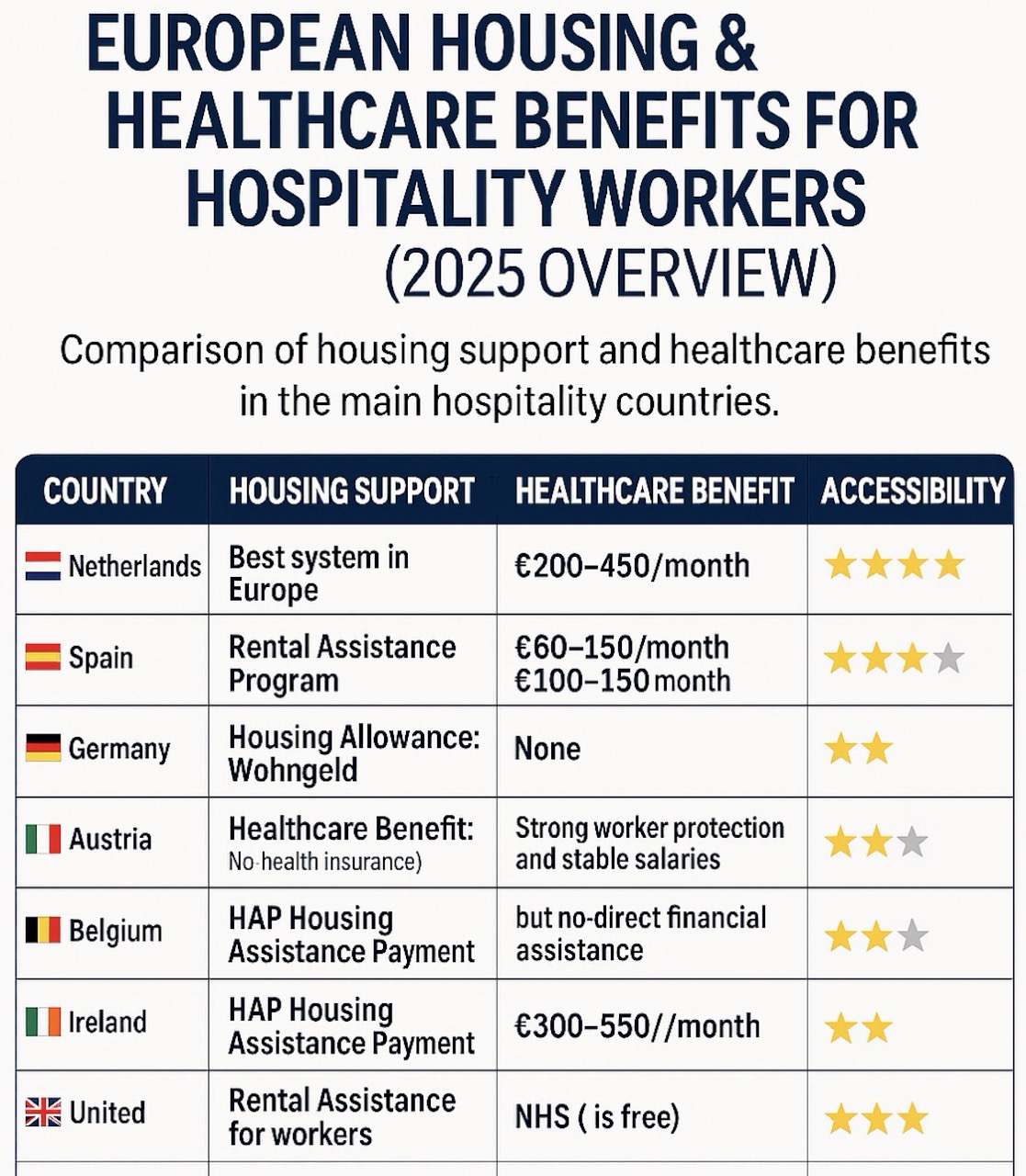
Housing & healthcare benefits in Ireland:
Ireland – housing & healthcare benefits for hospitality workers
Ireland in a European context
Ireland offers targeted housing and healthcare support
rather than broad national allowances.
On our overview page you can compare Ireland with other EU countries.
Hospitality benefits in Europe
Join our international community
Want to stay informed about living and working in European hospitality?
Join our international community: